Before deciding what your first product will look like, ask a more important question:
What problem are you trying to solve?
Perhaps your beauty brand is designed for people who struggle to find simple products for a particular skin concern. Maybe you’re creating makeup for a customer who feels overlooked by existing shades. Perhaps you want to build a fragrance brand around a particular mood, memory, or lifestyle.
The product matters, but the reason behind the product matters too.
A strong starting point is to understand what your customer is already struggling with.
What are they frustrated by?
What do they wish existed?
What do they find confusing about the products already available?
What would make them choose one brand over another?
You don’t need to have every answer before starting. But you should have enough clarity to know that your idea is solving something more meaningful than simply adding another product to the market.
One of the easiest mistakes to make when starting a beauty brand is trying to appeal to everyone.
It sounds logical.
You want your products to be suitable for as many people as possible, so you make the brand broad.
But broad messaging often becomes forgettable messaging.
Instead, think about the particular person you want your brand to speak to.
What does she care about?
What does she value?
What does she spend money on?
What kind of brands does she already admire?
Does she want something luxurious and refined, simple and practical, playful and expressive, or natural and understated?
You don’t need to create a fictional character with an unnecessarily complicated profile.
You simply need a clear understanding of the person you’re building for.
When you know your audience, decisions become easier. Your language becomes clearer. Your visual identity becomes more intentional. Even the way you photograph your products starts to make more sense.
This is where many new beauty brands rush.
They open Canva or hire a designer before deciding what they actually want to be known for.
Design cannot solve an unclear position.
Your positioning should answer a simple question:
Why should someone choose your beauty brand instead of another one?
Maybe your difference is the specific customer you serve.
Maybe it is your product philosophy.
Maybe it is your approach to luxury.
Maybe it is convenience, education, sustainability, experience, or a particular point of view.
Your difference doesn’t have to be something nobody has ever done before.
It simply needs to be meaningful to your customer and expressed consistently.
Once your position is clear, your design has something to communicate.
A beauty brand is not only recognised by its name.
People also recognise it by how it feels.
Think about the personality you want your brand to have.
Is it:
Sophisticated?
Warm?
Minimal?
Playful?
Bold?
Calm?
Feminine?
Modern?
Clinical?
Sensual?
You don’t need to choose ten personality traits.
Choose a small number that genuinely describe the world you want to create.
For example, a luxury skincare brand might lean towards refined, calm, and confident.
A playful beauty brand might feel energetic, expressive, and youthful.
Those choices eventually influence your typography, colours, photography, packaging, website, and content.
This is why branding should happen before you start decorating the business.
Your logo is important, but it isn’t your entire brand.
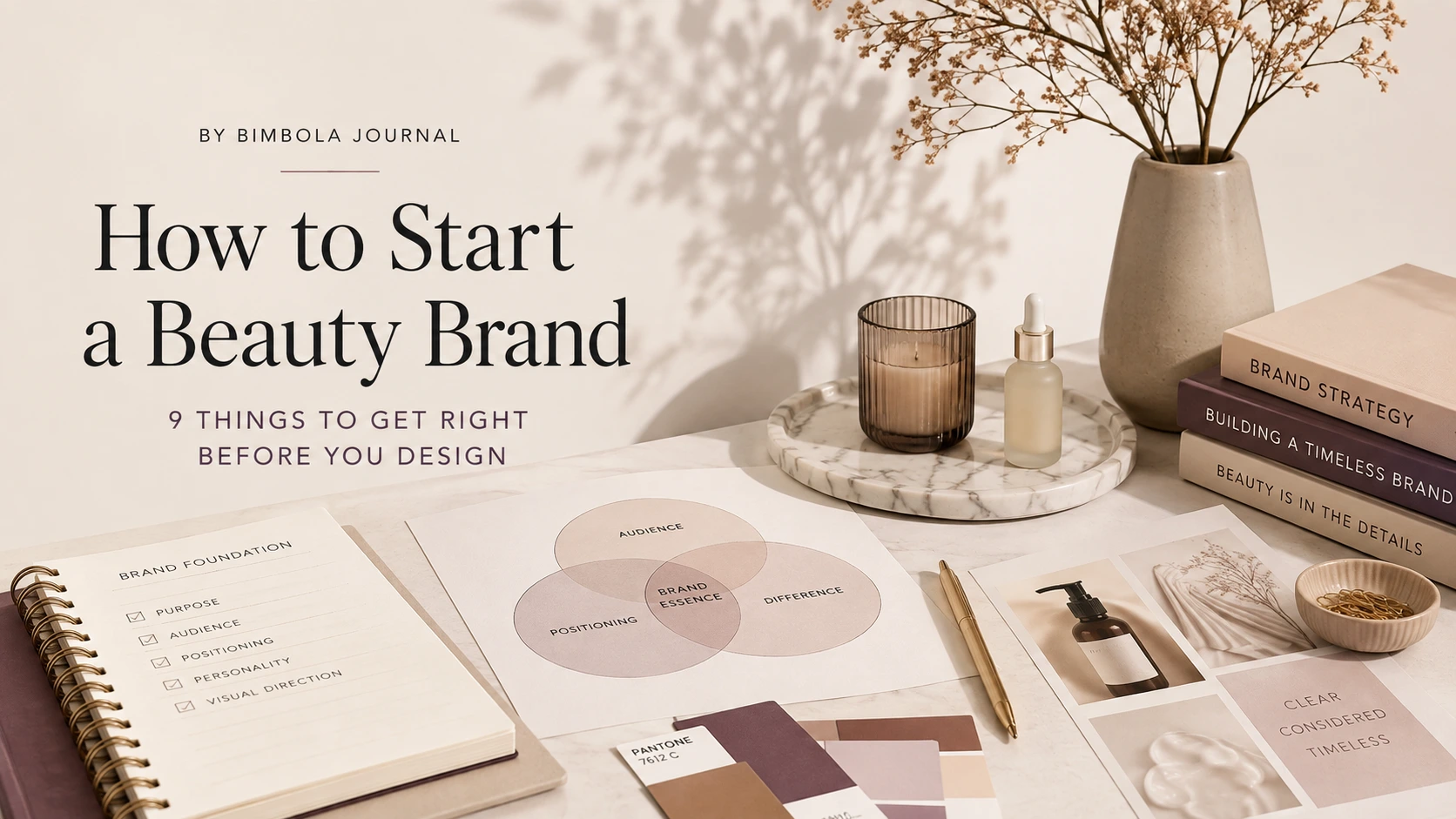
Before designing it, establish the foundation around it.
That can include your:
Brand purpose
Positioning
Audience
Personality
Values
Brand voice
Visual direction
Key message
Competitive difference
Once these decisions are clear, the visual identity has a much stronger direction.
The logo then becomes part of the system rather than being asked to carry the entire brand.
This is also where many founders save themselves from expensive redesigns later.
Changing a logo because you suddenly realise the brand feels too playful, too generic, or too luxurious is frustrating.
Changing it because your strategy evolved is different.
The first situation usually comes from designing too early.
Starting a beauty brand doesn’t mean you have to invent an entirely new category.
But you do need to understand the market you’re entering.
Look at the brands already serving your audience.
What are they doing well?
What do their products look like?
How do they speak?
What colours appear repeatedly?
What promises are they making?
Where are customers still complaining?
Most importantly, look for patterns.
If every competitor in your category uses the same beige packaging, for example, that doesn’t automatically mean you should avoid beige.
But it should make you ask whether your brand has a reason to follow that visual language or whether there is an opportunity to approach the category differently.
Research gives you context.
It also helps you avoid building a brand that accidentally looks like five other brands already on the shelf.
Your brand doesn’t stop at the packaging.
Think about what happens when someone first discovers you.
Then when they visit your website.
Then when they read your product description.
Then when their order arrives.
Then when they open the package.
Then when they use the product.
Then when they need help.
Every one of these moments contributes to the way people remember your business.
A strong beauty brand makes these moments feel connected.
The tone on Instagram shouldn’t feel completely different from the website.
The packaging shouldn’t feel disconnected from the brand identity.
The customer service experience shouldn’t contradict the promise you’re making.
People don’t experience your brand in separate design files.
They experience it as one business.
Beautiful branding matters.
But there is a difference between investing in your brand and spending money simply to make it look expensive.
When you’re starting a beauty brand, there are many things competing for your budget: product development, samples, testing, packaging, manufacturing, registration, photography, website development, marketing, and more.
The exact requirements will depend on what you’re selling and where you’re operating.
For founders in Nigeria, for example, cosmetic products are subject to NAFDAC registration requirements, so regulatory considerations need to be part of the planning process rather than something added at the very end.
Your branding budget should therefore sit inside the bigger business picture.
You don’t need the most elaborate identity in the market.
You need an identity that is clear, distinctive, appropriate for your audience, and flexible enough to grow with the business.
That is a much better investment.
Your first product probably won’t be your last.
Today you might sell one cleanser.
Tomorrow you may add a moisturiser, serum, body product, fragrance, or another category entirely.
Your brand identity should be able to accommodate that growth.
This doesn’t mean making everything generic so it can fit anything.
It means creating a system rather than designing one beautiful product in isolation.
Think about how your colours, typography, packaging structure, photography, messaging, and visual elements will work when the product range expands.
A strong identity gives you room to grow without losing recognition.
If you’re serious about how to start a beauty brand, don’t begin with the question:
“What should my logo look like?”
Start with:
“What am I building, who am I building it for, and what should this brand be known for?”
Then work outward.
Research the market.
Understand your customer.
Define your position.
Shape your personality and voice.
Build the brand foundation.
Then let the visual identity bring those decisions to life.
The design should not be the starting point.
It should be the expression of everything you’ve already decided.
Before you move from idea to launch, make sure you can answer:
Who is this brand for?
What problem or desire does it address?
Why should people choose it?
What makes it different?
What should people feel when they encounter it?
Does the visual identity communicate that feeling?
Can the brand grow beyond its first product?
If you can answer those questions clearly, you have something much more valuable than a pretty moodboard.
You have the beginning of a brand.