The short answer is: it depends on your business model.
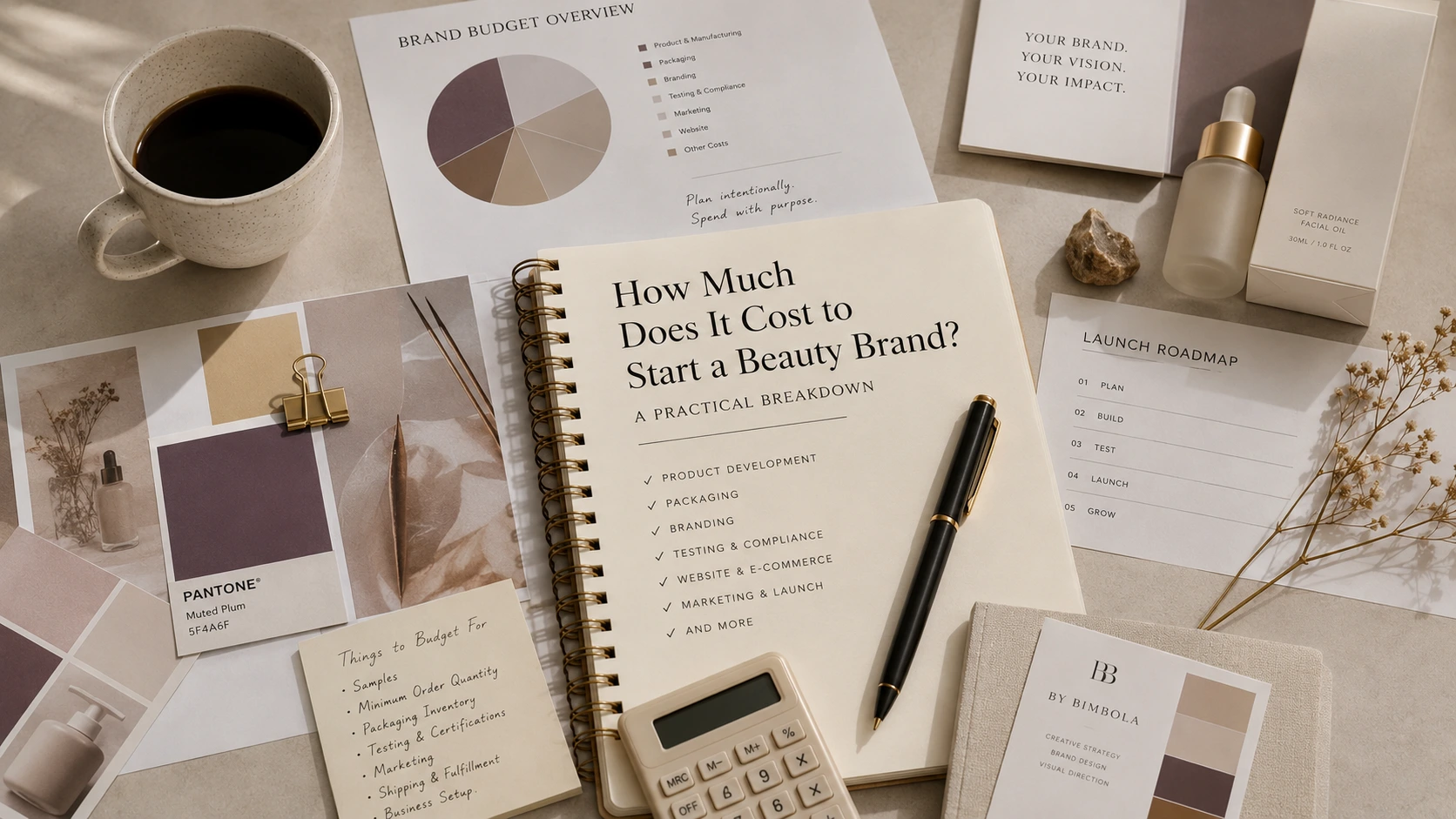
Your startup budget may need to cover:
Product development
Manufacturing
Packaging
Testing and quality control
Regulatory requirements
Business and brand registration
Brand strategy and identity
Photography and content
Website and e-commerce
Marketing
Initial inventory
Shipping and fulfilment
Some of these costs can be reduced when you’re starting small. Others shouldn’t be ignored simply because you’re working with a limited budget.
For example, in Nigeria, cosmetic products are regulated by NAFDAC. NAFDAC’s guidelines state that cosmetics manufactured, imported, exported, advertised, sold, distributed or used in Nigeria must be registered in accordance with the relevant requirements.
So the real question isn’t simply:
“How little can I spend?”
It is:
“What does my particular beauty brand need to launch properly?”
Before you calculate anything, decide how you’re going to create the product.
This can have a major effect on your budget.
Private label
With private label, you work with an existing formulation or product and sell it under your own brand.
This can be a more accessible route for a new founder because you aren’t developing an entirely new formula from scratch.
For example, Nigerian beauty manufacturer OUI Life currently lists private-label development from ₦50,000, semi-custom development from ₦100,000 and custom formulation from ₦150,000 per product, while noting that production, packaging inventory, third-party testing and regulatory fees are separate unless specifically included in a quotation.
Those figures are examples, not a universal industry price list.
Your actual cost will depend on the manufacturer, product, quantity, packaging and requirements.
Semi-custom
This sits somewhere between private label and completely custom formulation.
You might begin with an existing base and modify certain elements such as actives, concentration or other product characteristics.
It can give a founder more control without requiring the same level of development as a completely new formula.
Custom formulation
This is where you develop a product specifically around your brief.
It can offer more differentiation, but it can also require more development, testing, sampling and time.
If your budget is limited, you don’t necessarily need to begin here.
The right choice depends on what you want your brand to compete on.
Once you’ve decided how your product will be developed, you need to think about production.
This is where your budget can increase quickly.
Your manufacturing cost can depend on:
Product type
Ingredients
Formula complexity
Quantity
Minimum order quantity
Packaging format
Filling requirements
Labelling
Manufacturing location
Quality control requirements
One of the biggest mistakes a new founder can make is producing too much too early.
Imagine launching with five products when you haven’t yet established which product customers actually want.
You could end up with a large amount of money sitting in inventory.
Starting with one strong product or a very small range can sometimes make more sense.
The goal isn’t to make your launch look enormous.
The goal is to give the business room to learn.
Beauty is a visual industry, so packaging naturally becomes an important part of the investment.
But packaging costs can vary dramatically.
You could use:
Stock bottles
Stock jars
Standard tubes
Custom boxes
Custom bottles
Printed labels
Custom finishes
Foiling
Embossing
Special closures
Custom packaging can look beautiful, but it isn’t automatically the best choice for a new brand.
Sometimes a well-designed label on a simple container can feel more distinctive than expensive packaging with no clear concept behind it.
This is where strategy matters.
Your packaging should communicate what the product is, who it’s for and where it sits in the market.
You don’t need to spend the most.
You need to spend intentionally.
This is one area where I would never recommend simply cutting costs.
If you’re selling cosmetics, your product needs to meet the relevant regulatory and safety requirements for the market you’re entering.
For Nigerian founders, NAFDAC provides official guidance and an online registration system for regulated products. Its cosmetics registration guidelines also list documentation such as evidence of business incorporation, contract manufacturing agreements where applicable, trademark registration evidence, product labels or artwork and certificates of analysis.
NAFDAC’s current services portal also provides a cost estimator and processing-time tools for regulatory applications.
That means your budget shouldn’t only account for the product sitting inside the bottle.
It needs to account for the work required to bring that product to market properly.
If you’re working with a manufacturer, ask exactly what their quotation includes.
Does it include:
Sampling?
Testing?
Packaging?
Labelling?
Documentation?
Regulatory support?
Production?
Never assume.
This is the part I care about particularly as a brand strategist.
A beauty brand needs more than a logo.
You may need:
Brand strategy
Positioning
Naming
Logo
Colour system
Typography
Packaging direction
Brand voice
Art direction
Brand guidelines
But that doesn’t mean you need to spend a huge amount on every item before launching.
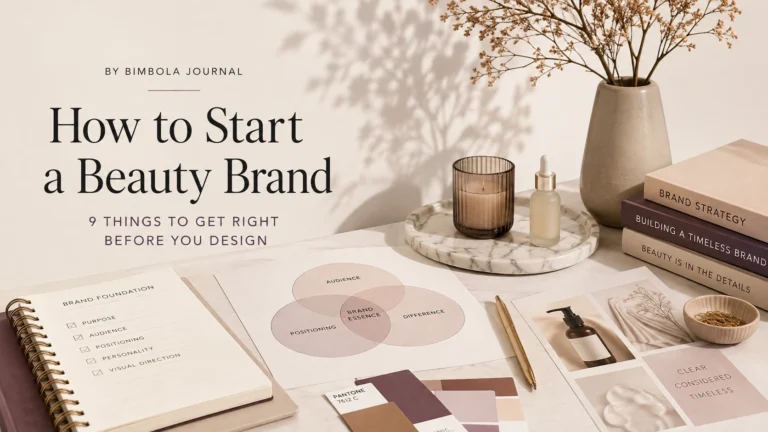
Before you start spending money on the visual side of your brand, it helps to understand what needs to be in place first. I wrote more about this in How to Start a Beauty Brand: 9 Things to Get Right Before You Design.
The important question is:
What does your brand need to communicate?
If your audience is buying a premium skincare product, your identity should feel appropriate to that positioning.
If you’re building an accessible body-care brand for a younger audience, the visual language might need to be completely different.
Your branding budget should therefore be connected to your business strategy.
A logo designed without that strategy can look nice and still fail to communicate anything meaningful.
Once you have the product and the identity, people need to see it.
This means you will probably need some form of visual content.
That might include:
Product photography
Lifestyle photography
Short-form video
Social media graphics
Website imagery
Launch content
Educational content
Again, you don’t necessarily need a huge production on day one.
A small, carefully art-directed shoot can give you much more useful content than a large shoot with no clear creative direction.
Think about how one shoot can create:
Website images
Instagram posts
Pinterest Pins
Product pages
Launch graphics
Email content
The goal is to make your content investment work harder.
A new beauty brand doesn’t necessarily need a complicated website with twenty pages.
At minimum, you need a clear place where people can understand:
What you sell.
Who it’s for.
Why they should trust you.
How to buy.
Your website might begin with:
Homepage
Shop
Product pages
About
Contact
FAQs
Shipping/returns
Privacy and terms pages
The important thing is clarity.
A beautiful website that makes customers work to understand the product isn’t doing its job.
One of the easiest mistakes is spending almost everything on product and packaging and then having nothing left to actually introduce the brand to people.
You need to think about how customers will discover you.
That might include:
Instagram
Pinterest
TikTok
Influencer partnerships
Search
Email marketing
Paid advertising
Launch events
PR
Content marketing
You don’t need to use every channel.
Choose the ones that make sense for your audience and your capacity.
And remember that marketing isn’t only something you do after the product is ready.
Your positioning, content and audience-building can begin much earlier.
There are also smaller costs that can easily disappear from your initial calculation.
Depending on your business and location, these can include:
Business registration
Trademark-related costs
Domain name
Business email
Website hosting
Payment processing
Shipping materials
Storage
Professional services
Accounting
Legal support
Individually, some of these may not seem significant.
Together, they can affect your actual launch budget.
This is why I recommend creating a simple spreadsheet before spending anything.
List every expected expense.
Then separate them into:
Must have
Important
Can wait
That alone can prevent a lot of unnecessary spending.
Instead of saying every beauty founder needs the same amount of money, I prefer to think about launches in terms of scale.
A lean launch
You might:
Start with one product
Use existing formulations
Choose stock packaging
Keep your initial inventory relatively small
Build a focused brand identity
Create your own early content
Launch through a simple website
Focus on one or two marketing channels
This approach is about validating the idea before making bigger investments.
A more developed launch
You might:
Launch with two or three products
Invest more heavily in packaging
Develop a stronger visual identity
Produce professional photography
Build a fuller e-commerce experience
Allocate money towards marketing
This gives you more room to create a polished launch while still keeping the product range focused.
A larger launch
You might be investing in:
Multiple SKUs
Custom formulation
Custom packaging
Larger inventory
Professional creative production
A more extensive website
Influencer or PR campaigns
Paid advertising
Larger operational infrastructure
This can create a more substantial launch, but it also means taking on more financial risk.
The important thing is that bigger doesn’t automatically mean better.
There are a few things I would be careful about.
Ordering too much inventory
A full shelf of products doesn’t mean you have a successful brand.
You need customers first.
Spending heavily on packaging before understanding the positioning
Beautiful packaging can’t fix an unclear brand.
Launching too many products
More products mean more inventory, more content, more packaging and more things to manage.
Trying to look “luxury” by simply spending more
Luxury isn’t just expensive materials.
It’s clarity, restraint, consistency, experience and attention to detail.
Spending everything on the launch
Your launch isn’t the end of the business.
You’ll still need money for marketing, restocking, improvements and unexpected costs.
Before deciding what to spend, I would start by getting clear on the foundations of the brand.
I would keep the first version of the brand focused.
I would rather have:
one strong product + clear positioning + thoughtful branding + good packaging + useful content
than:
six products + expensive packaging + no money left for marketing.
I would also validate the product and audience as early as possible.
Talk to potential customers.
Study competitors.
Look at what people complain about.
Understand what they’re already buying.
Then use those insights to shape the brand.
And when it comes to branding, I would make sure the identity is strong enough to establish recognition from the beginning, but flexible enough to grow as the business does.
There’s a difference between looking cheap and starting small.
A small beauty brand can still feel considered.
It can have beautiful typography.
A thoughtful colour palette.
Clear packaging.
Strong photography.
Consistent messaging.
A good website.
A distinctive point of view.
None of those things require you to pretend that you’re already a huge company.
In fact, restraint can sometimes make a young brand feel more confident.
You don’t have to communicate:
“Look how much money we spent.”
You need to communicate:
“We know exactly what we’re doing.”
That’s a much stronger impression.
If you’re asking how much it costs to start a beauty brand, I wouldn’t begin by choosing a random figure from someone else’s launch story.
Start with your model.
Ask:
What am I selling?
How many products am I launching?
Am I using private label, semi-custom or custom formulation?
What quantity do I actually need?
What packaging makes sense?
What regulatory requirements apply?
What does my brand need to communicate?
How will people discover it?
How much cash needs to remain after launch?
Then build your budget around those answers.
A current Nigerian private-label manufacturer, for example, publicly lists different development routes starting from ₦50,000 to ₦150,000 depending on whether the product is private label, semi-custom or custom formulation, while separately noting that production, packaging inventory, testing and regulatory costs can change the final figure.
That’s exactly why a single number can be misleading.
Your beauty brand budget should be specific to your product and your strategy.