Let’s keep this simple.
Beauty brand differentiation is what makes your brand meaningfully different from the other brands competing for your customer’s attention.
This connects to the broader idea of brand building, which the American Marketing Association’s branding resources also explores.
It answers a simple question:
“Why this brand?”
Not just:
“What do you sell?”
And not even:
“Who is your product for?”
But:
“Why should someone choose your brand instead of the alternatives?”
Your difference doesn’t have to come from inventing something nobody has ever seen before.
There are already thousands of skincare brands.
Thousands of body care brands.
Thousands of fragrance brands.
Thousands of lip products.
Trying to create a category that has never existed before isn’t always realistic or necessary.
Your difference can come from the way you approach an existing category.
Maybe you serve a very specific customer.
Maybe your brand has a distinctive philosophy.
Maybe you simplify something that has become unnecessarily complicated.
Maybe you create a particular emotional experience.
Maybe your storytelling comes from a perspective other brands aren’t expressing.
Maybe your product approach solves a familiar problem in a more thoughtful way.
That is where beauty brand differentiation starts becoming interesting.
This is an important distinction.
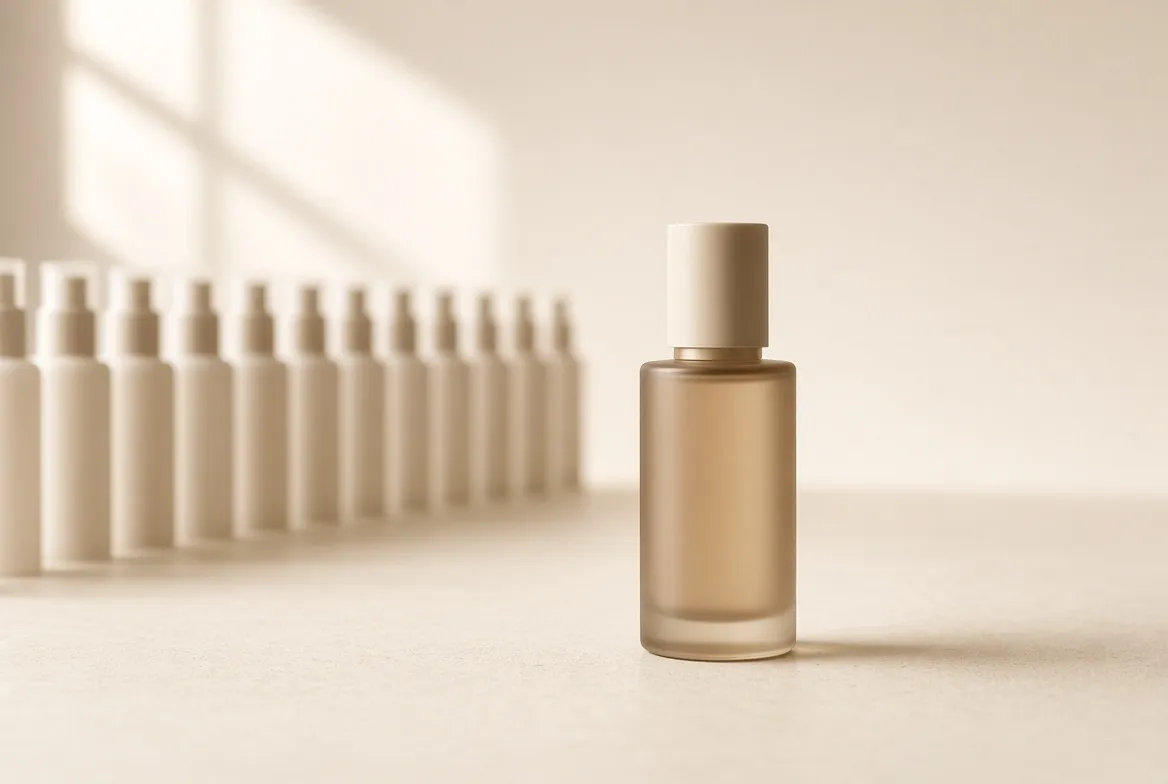
A brand can look different without actually being differentiated.
A strong beauty brand identity should communicate more than visual taste; it should help express what makes the brand distinct.
You can choose an unusual colour palette.
Use an unconventional typeface.
Create interesting packaging.
Shoot your products in a completely different way.
And still have a brand that doesn’t give people a strong reason to choose it.
Why?
Because visual difference and strategic difference aren’t necessarily the same thing.
Imagine a skincare brand with bright orange packaging in a market full of beige and white packaging.
It will probably stand out on a shelf.
But if the product, messaging, audience and overall experience feel exactly like everything else, that visual difference may only get you attention.
It doesn’t necessarily give you recognition.
This is why beauty brand differentiation shouldn’t begin with:
“How can we make this look different?”
A better question is:
“What makes this brand worth choosing?”
Once you understand that, creative direction for beauty brands becomes much more meaningful because you’re translating a strategic difference into a visual and creative world.
If you’ve read my previous article on brand positioning for beauty brands, this is where the two ideas connect.
Positioning asks:
What do you want your brand to be known for?
Differentiation asks:
What makes that position worth choosing?
You need both.
Let’s say two beauty brands both target people with dry skin.
That’s their category and audience.
But one brand may position itself around making body care feel like a calming evening ritual.
Another may focus on straightforward, effective care for people who don’t want complicated routines.
Both sell moisturising products.
But the brands are beginning to occupy very different spaces.
That’s the real opportunity behind beauty brand differentiation.
You aren’t necessarily changing the category.
You’re changing the reason people connect with your brand within that category.
Strong beauty brand differentiation often starts with knowing what you want your brand to mean within the category, not simply how you want it to look.
This is one of the easiest traps for beauty brands to fall into.
A founder says:
“I want my brand to feel luxurious.”
So the brand gets:
Gold details.
Elegant typography.
Dark packaging.
High-end photography.
A sophisticated website.
And suddenly, it looks expensive.
But does it feel distinctive?
Not necessarily.
Because “luxury” is a positioning direction used by countless beauty brands.
The more useful question is:
What does luxury mean for your customer?
Maybe it’s a slower, more sensorial experience.
Maybe it’s exceptional customer service.
Maybe it’s beautifully considered packaging.
Maybe it’s giving customers the feeling that their everyday routine deserves more attention.
Maybe it’s exclusivity.
Maybe it’s simplicity.
Once you define what that word actually means for your brand, you have something more useful to build around.
That’s where beauty brand differentiation moves beyond aesthetics.
You aren’t simply trying to look luxurious.
You’re defining what your version of luxury actually means.
Beauty trends can be useful.
They can show you what customers are responding to.
They can give you creative inspiration.
They can help your brand feel current.
But there is a difference between being inspired by a trend and building your entire brand around it.
If every new trend changes your colours, content style, packaging direction or photography, your brand can slowly lose its own identity.
One month you’re minimalist.
The next you’re colourful.
Then suddenly you’re editorial.
Then you’re leaning into a “quiet luxury” aesthetic because everyone else is.
At some point, the question becomes:
What actually belongs to us?
A strong brand can evolve without constantly reinventing itself.
And that’s an important part of building beauty brand differentiation.
You should be able to recognise what makes your brand yours even when the visual trends around it change. That’s also what gives brand recognition something consistent to build on over time.
That’s one of the clearest signs of beauty brand differentiation: your brand can evolve without losing the qualities that make it recognisable.
One of the easiest ways to find a point of difference is to stop asking:
“What can I add?”
and start asking:
“What’s missing?”
Look closely at the category you’re entering.
What are customers constantly complaining about?
What feels unnecessarily complicated?
What are brands overlooking?
What does everyone seem to communicate in exactly the same way?
What kind of customer is being underserved?
What expectations have customers simply accepted because “that’s how the industry works”?
You don’t have to solve all of these problems.
You’re looking for an opportunity.
For example, if every skincare brand in a particular space is communicating in highly technical language, perhaps there’s room for a brand that makes skincare education feel much simpler and more human.
If body care is constantly presented as purely functional, perhaps there’s an opportunity to make the ritual itself the centre of the experience.
If fragrance marketing feels overly focused on status and exclusivity, perhaps there’s room for a brand built around personal expression and storytelling.
The opportunity for beauty brand differentiation can sometimes be hiding in something customers have stopped questioning.
Your beauty brand doesn’t need to follow every trend to get noticed.
It needs a clear reason to exist, a point of view worth remembering and a creative direction that makes those ideas visible.
Beauty brand differentiation isn’t about trying to look completely different from everyone else. It’s about understanding what makes your brand worth choosing and reinforcing that difference consistently.
Before changing your colours, redesigning your packaging or following the next beauty trend, ask yourself:
What makes this brand ours?
If you can answer that clearly, you have something much more valuable than another trend-led aesthetic.
You have the foundation for a brand people can recognise, understand and remember.